Manikandan Nishanth

Scientific Computing | Computational Mechanics

I am a reseach aspirant, who is interested in scientific computing, particularly finite element methods and computational fluid dynamics. I am motivated to further explore how parallel algorithms can be used to implement mathematical models efficiently.

Manikandan Nishanth

About Me

I graduated from IIT Madras (Mechanical Engineering) in 2025.

My previous work involves developing finite element models for fracture mechanics and exploring numerical techniques for solving nonlinear coupled problems. I have also implemented CFD solvers for incompressible flow using finite difference methods.

I enjoy bridging the gap between mathematical formulations and their computational realization.

My hobbies include reading fiction, exploring new programming languages and playing tennis.

Projects

Phase-Field Modeling of Chemo-Mechanical Fracture in Battery Electrodes

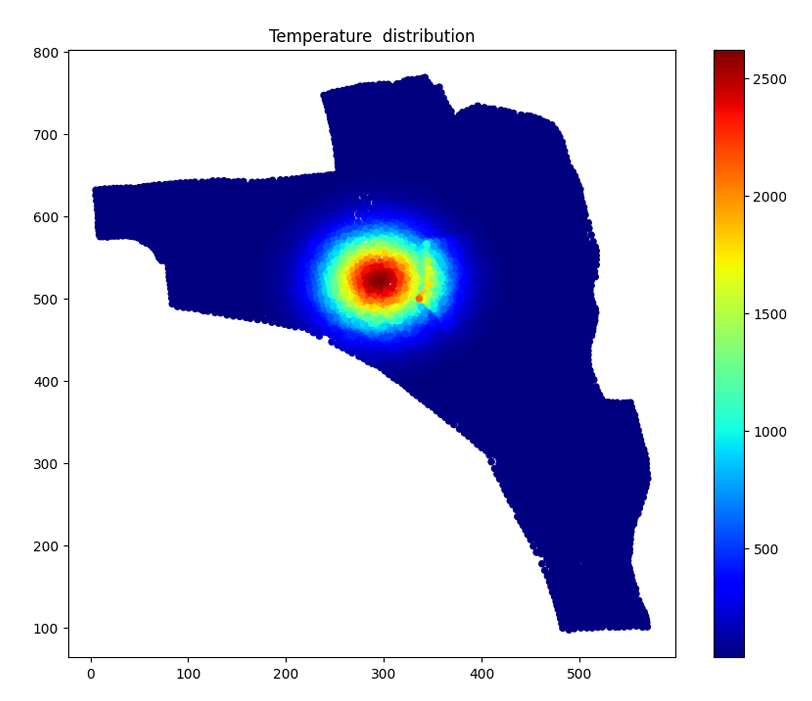
Developed a nonlinear finite element framework to model fracture behavior in battery electrodes using a phase-field approach. The formulation accounts for chemo-mechanical coupling and evolving damage fields.

Focus: Nonlinear FEM, Phase-field methods, Coupled systems

Lid-Driven Cavity Flow using Stream Function - Vorticity Formulation

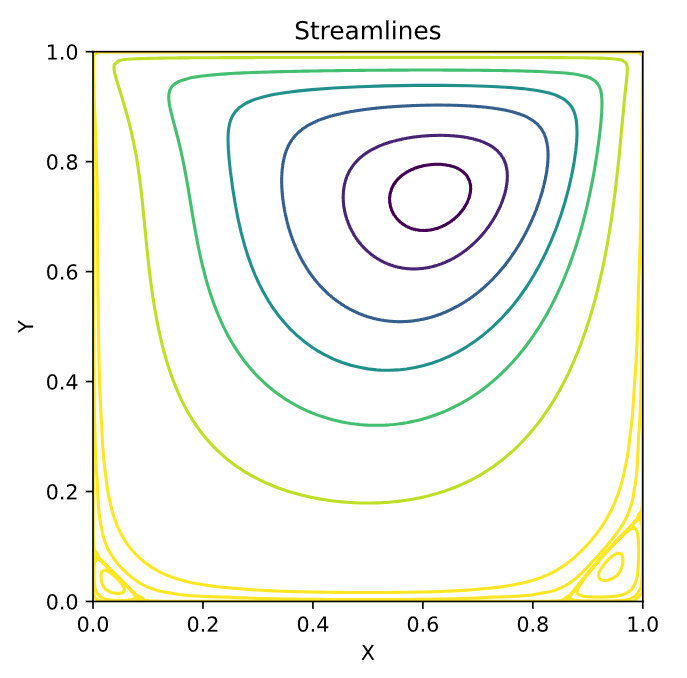
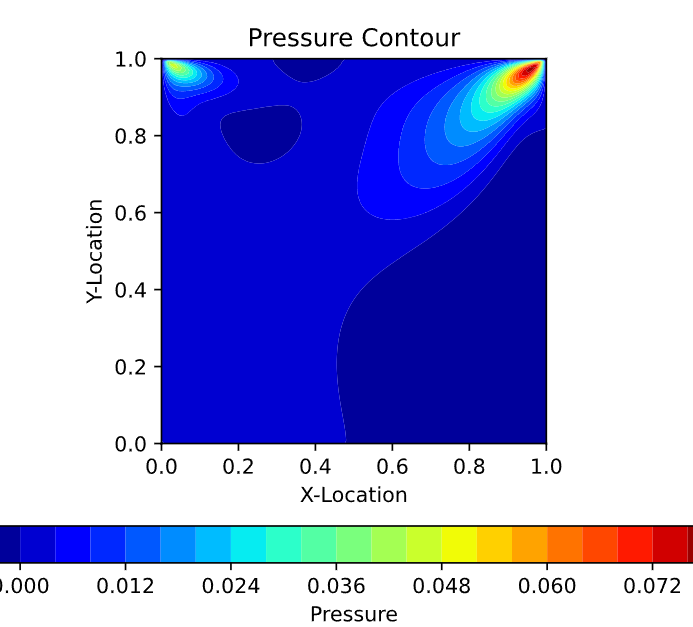
Implemented a numerical solver for incompressible flow using the stream function–vorticity formulation. Investigated flow structures and convergence behavior across Reynolds numbers.

Focus: CFD, Finite difference methods, Numerical stability

Development of Numerical Solvers for fluid flow (Ongoing)

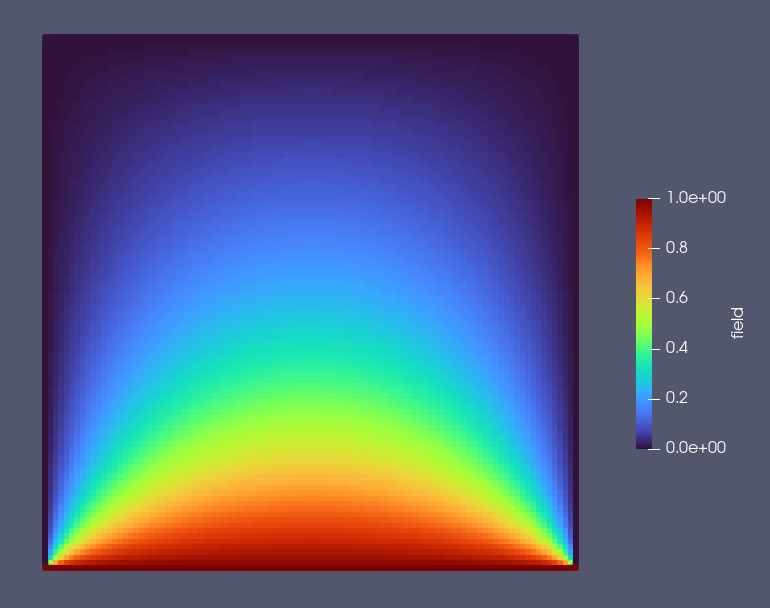
Building CFD solvers for transport problems, with emphasis on stability, discretization strategies, and convergence characteristics. I am seeking to implement parallel algorithms for large-scale simulations in the future.

Focus: CFD, Finite volume methods, Differential equations, Parallel computing

×
Image 1

Phase-Field Modeling of Chemo-Mechanical Fracture in Battery Electrodes

Abstract

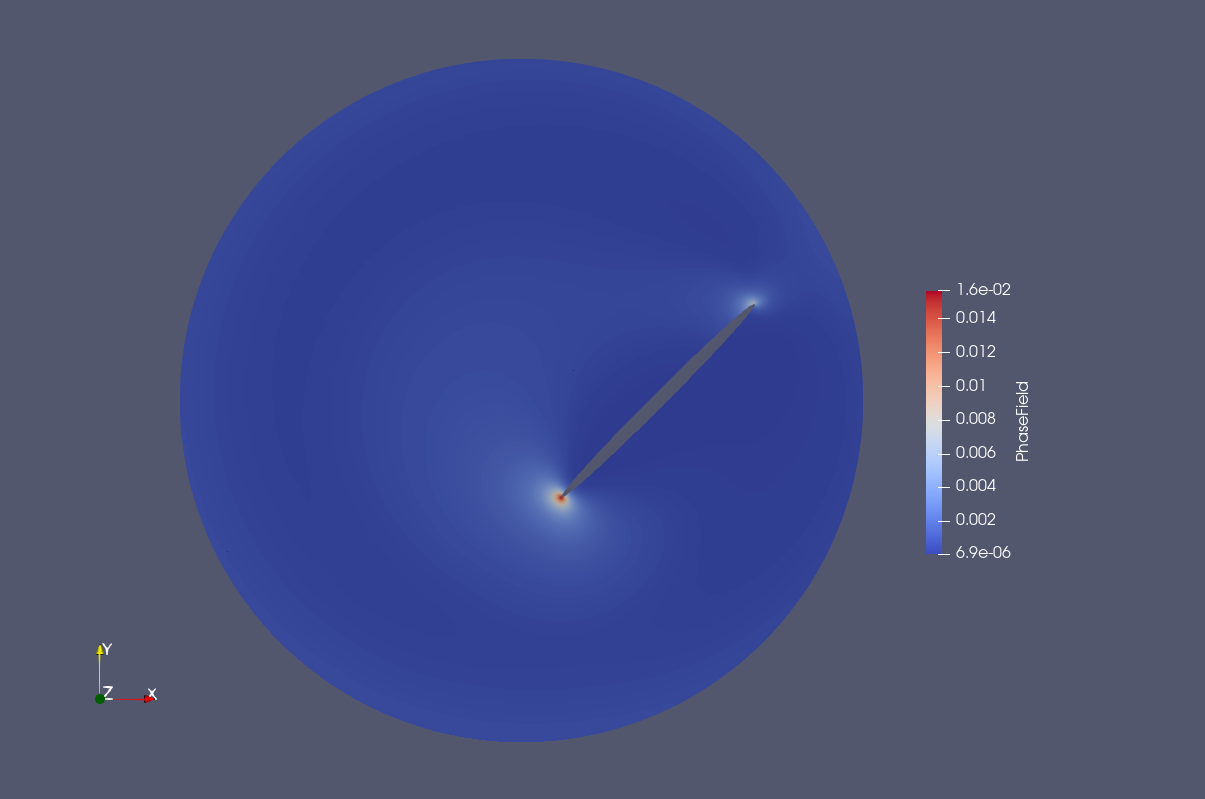
Solid-state batteries (SSBs) offer significant advantages over conventional lithium-ion batteries, including improved safety, higher energy density, and enhanced electrochem ical stability. However, mechanical degradation of solid-state electrodes due to stress accumulation during lithium-ion diffusion remains a major challenge. In this work, we present a computational framework to predict fracture in electrode particles under coupled electro-chemo-mechanical loading conditions using a variational phase-field model. The boundary flux is governed by the Butler–Volmer equation, enabling the simulation of potentiodynamic conditions where current depends nonlinearly on both voltage and concentration gradients. The governing equations are solved using the finite element method with a monolithic Newton–Raphson scheme for chemo-mechanical fields and a staggered scheme for the phase-field evolution. To validate the model’s ability to capture geometry-dependent crack patterns, we simulate a circular particle with elliptical notches oriented at different angles. Our results highlight the influence of notch orientation and diffusion-induced stress on crack initiation and propagation. This work provides key insights into the design of fracture-resistant electrode materi als and serves as a foundation for developing predictive tools for battery durability in solid-state systems.
×
Image 2

Lid-Driven Flow of Fluid Inside a Cavity using Vorticity-Stream Function Method

Description

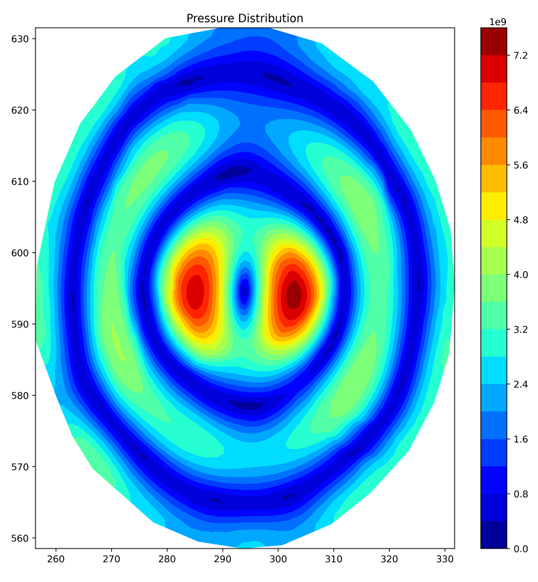
Developed a 2D lid-driven cavity flow solver using the Finite Difference Method to simulate incompressible flow with vorticity-streamline function formulation, validating centerline velocity profiles against U. Ghia et al. (1982) benchmark data. Performed detailed flow field analysis including streamline patterns, vorticity contours, and pressure distribution, demonstrating strong agreement with benchmark results. Investigated numerical scheme limitations, highlighting the reduced stability and accuracy of central differencing at higher Reynolds numbers and identifying the need for higher-order upwind schemes for convection-dominated regimes.

×
Image 3

Development of Numerical Solvers for fluid flow (Ongoing)

Description

Building CFD solvers for transport problems, with emphasis on stability, discretization strategies, and convergence characteristics. I am seeking to implement parallel algorithms for large-scale simulations in the future.

Research Interests

Finite Element Methods

Development of numerical formulations for solving coupled and nonlinear physical systems with emphasis on stability and accuracy.

Computational Fluid Dynamics

Numerical simulation of fluid flow using discretization techniques, with focus on convection-dominated problems and flow stability.

Scientific Computing

Efficient implementation of numerical algorithms in C++ for large-scale computational problems.

Contact

Feel free to reach out for discussions on scientific computing, numerical methods, or potential collaborations.